

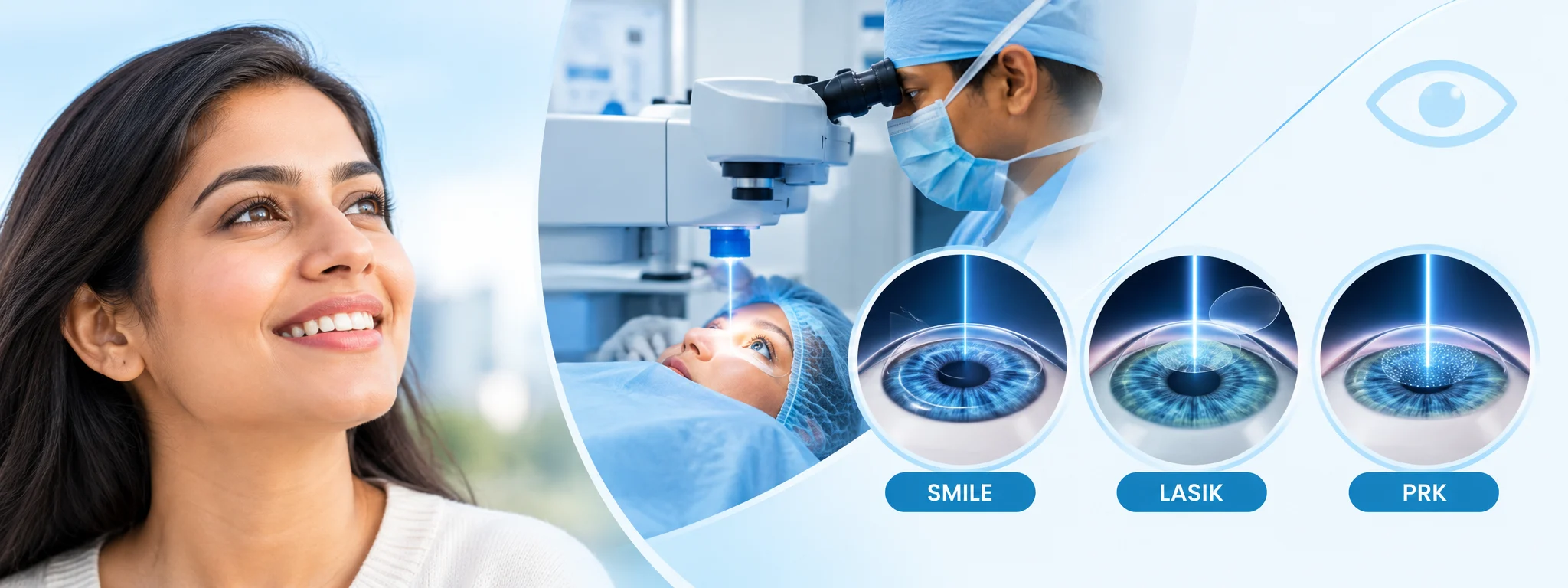
What Are SMILE, LASIK & PRK?
Learn how these three laser vision correction procedures work, how they differ, and why your eye health and visual needs matter when choosing a treatment.
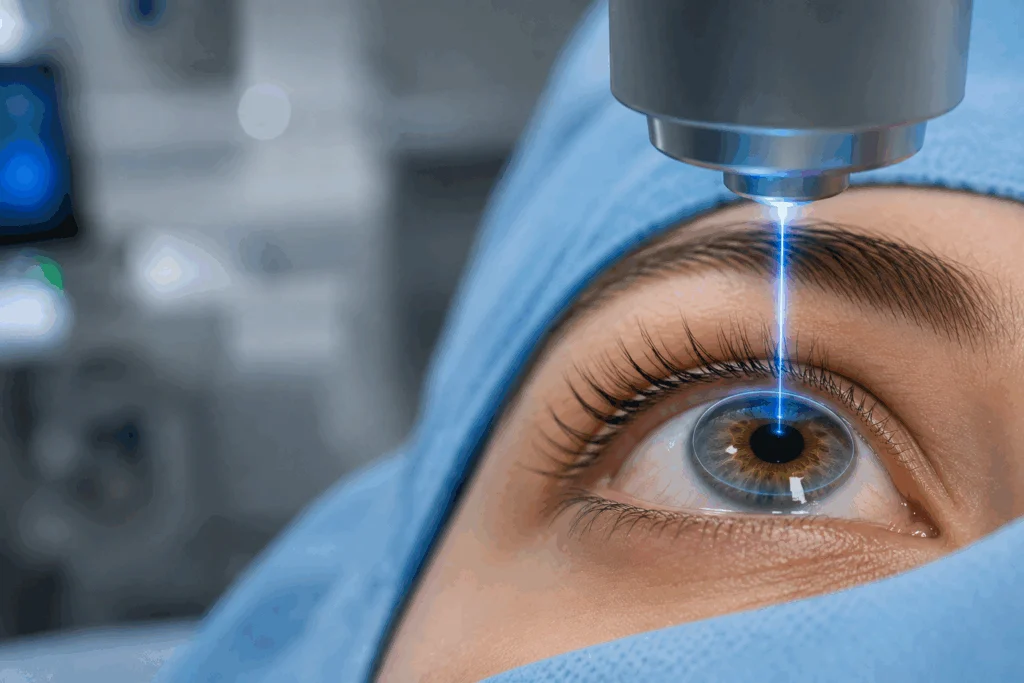
SMILE Small Incision Lenticule Extraction
SMILE is a minimally invasive laser vision correction procedure. A femtosecond laser creates a small piece of corneal tissue called a lenticule inside the cornea. The surgeon then removes the lenticule through a small incision, changing the shape of the cornea and correcting the refractive error.
Unlike LASIK, SMILE does not require a traditional corneal flap. This can be an important consideration for people involved in contact sports or activities where the eye may experience accidental trauma.
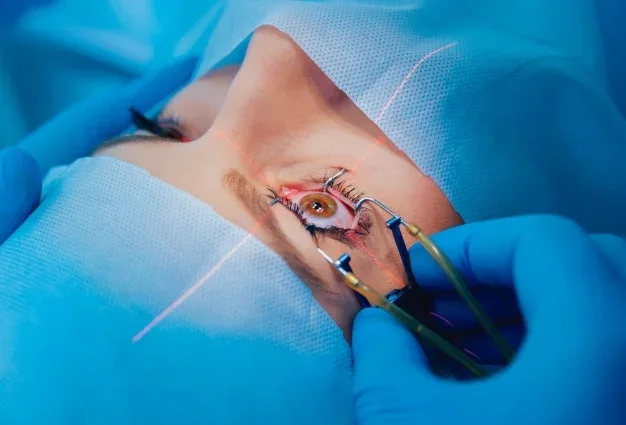
LASIK Laser-Assisted In Situ Keratomileusis
LASIK is one of the most established forms of laser vision correction. During LASIK, a thin corneal flap is created. The underlying corneal tissue is then reshaped using an excimer laser before the flap is repositioned.
LASIK can correct common refractive errors such as myopia, hyperopia, and astigmatism, depending on individual eye measurements and the treatment platform being used.
PRK Photorefractive Keratectomy
PRK is another laser vision correction procedure. Unlike LASIK, PRK does not create a corneal flap. Instead, the outer epithelial layer of the cornea is removed to expose the underlying tissue.
The cornea is then reshaped using an excimer laser. The epithelial layer subsequently heals over the treated area.

How Does SMILE, LASIK & PRK Work?
Each laser vision correction procedure uses a different approach to reshape the cornea. Learn how SMILE, LASIK and PRK work and what makes each procedure different.
SMILE Eye Surgery
Before SMILE surgery, the ophthalmologist performs detailed measurements of the eyes and cornea. These may include refraction, corneal mapping, corneal thickness measurements, and assessment of the overall health of the eye.
During the procedure, a femtosecond laser creates a precise lenticule within the cornea. A small incision is then used to remove the lenticule. Removing this tissue changes the corneal shape and helps correct the refractive error.
Because SMILE uses a small incision rather than a LASIK flap, it may be particularly relevant for patients concerned about flap-related issues.
SMILE uses a small corneal incision instead of creating a traditional LASIK flap.
LASIK Eye Surgery
LASIK begins with a comprehensive eye examination. The surgeon checks the stability of your prescription, corneal shape and thickness, tear film, pupil characteristics, and overall eye health.
During surgery, a thin flap is created in the cornea. An excimer laser then removes microscopic amounts of corneal tissue according to the patient's prescription and treatment plan.
One of the main advantages of LASIK is its typically rapid visual recovery. However, laser vision correction does not guarantee perfect vision or eliminate the possibility of needing glasses in the future.
LASIK uses a thin corneal flap followed by precise reshaping with an excimer laser.
PRK Eye Surgery
PRK uses an excimer laser to reshape the cornea, but unlike LASIK, there is no corneal flap. The surface epithelial layer is removed before laser treatment and then regenerates during the healing process.
The absence of a flap can be useful for selected patients. However, because the corneal surface needs to heal, PRK generally has a longer initial recovery period than LASIK.
Patients may experience discomfort, light sensitivity, watering, or blurred vision during the early healing stage.
PRK does not create a corneal flap, but the surface layer needs time to heal.
SMILE vs LASIK vs PRK – What Is the Difference?
SMILE, LASIK and PRK are different laser vision correction procedures. The main differences include how the cornea is treated, recovery considerations and whether a corneal flap is created.
| Comparison | SMILE Small Incision Lenticule Extraction | LASIK Laser-Assisted In Situ Keratomileusis | PRK Photorefractive Keratectomy |
|---|---|---|---|
| Procedure Approach | A femtosecond laser creates a lenticule inside the cornea, which is removed through a small incision. | A thin corneal flap is created, followed by reshaping of the underlying corneal tissue using an excimer laser. | The outer epithelial layer is removed and the exposed corneal tissue is reshaped using an excimer laser. |
| Corneal Flap | No flap | Flap created | No flap |
| Laser Used |
Femtosecond laser
Used to create the lenticule. |
Femtosecond or other flap-creation technology plus an excimer laser, depending on the treatment platform. |
Excimer laser
Used to reshape the cornea. |
| Corneal Incision | Small incision used to remove the lenticule. | A corneal flap is created to access the underlying tissue. | No corneal flap is created. The surface epithelial layer is removed. |
| Early Recovery | Recovery is generally relatively quick, although individual experiences vary. | Visual recovery is typically rapid, although recovery differs between patients. | Initial recovery is generally longer because the surface epithelial layer needs to heal. |
| Early Discomfort | Some patients may experience temporary discomfort, dryness or visual fluctuations. | Temporary dryness, irritation or other short-term symptoms may occur. | Early discomfort, light sensitivity, watering or blurred vision can occur while the surface heals. |
| Common Treatment Uses | Commonly used for myopia and certain types of astigmatism, depending on the patient's measurements and approved treatment range. | Can be used to correct myopia, hyperopia and astigmatism in appropriately selected patients. | Can be used for selected refractive errors, depending on corneal characteristics and treatment eligibility. |
| Flap-Related Consideration | No flap Does not involve a traditional LASIK corneal flap. | Involves a corneal flap, which is an important consideration during patient selection and counselling. | No flap Does not involve a traditional LASIK corneal flap. |
| Patient Suitability | Suitability depends on corneal measurements, prescription, eye health and other clinical factors. | Suitability depends on corneal thickness, corneal shape, prescription, tear film and overall eye health. | May be considered for selected patients based on corneal characteristics, lifestyle and overall eye health. |
| Need for Glasses | May reduce dependence on glasses, but complete freedom from glasses cannot be guaranteed. | May reduce dependence on glasses, but some patients may still need spectacles for certain activities. | May reduce dependence on glasses, but individual results vary. |
Frequently Asked Questions About SMILE, LASIK & PRK
Find answers to common questions about SMILE, LASIK and PRK laser eye surgery.
The main difference is the surgical technique used to reshape the cornea. SMILE uses a small incision to remove a corneal lenticule, LASIK creates a corneal flap before laser reshaping, and PRK removes the surface epithelium before reshaping the cornea with an excimer laser.
SMILE is not universally better than LASIK. Both procedures can provide good visual outcomes in appropriately selected patients. The suitable procedure depends on factors such as your prescription, corneal measurements, eye health, lifestyle, and individual needs.
LASIK and SMILE generally have faster early visual recovery than PRK. PRK requires additional time for the corneal surface to heal, so vision may remain blurry or uncomfortable for longer during the initial recovery period.
PRK can cause more discomfort during the first few days compared with LASIK because the surface layer of the cornea needs to heal. Your ophthalmologist can prescribe medication and other treatments to help manage discomfort during recovery.
These procedures are designed to reduce dependence on glasses or contact lenses, but they cannot guarantee that you will never need glasses again. Vision can change naturally with age, and some patients may still require glasses for certain activities.
The answer depends on the individual's complete corneal evaluation. PRK may be considered in some patients when LASIK is not appropriate, but thin corneas can also be associated with other conditions that need careful evaluation. Your ophthalmologist should determine whether laser vision correction is safe for you.
Dry eye is an important consideration before laser vision correction. LASIK, SMILE, and PRK can affect the eye's surface and may temporarily worsen dry-eye symptoms. Your doctor should assess and, if necessary, manage dry eye before deciding on surgery.
The actual laser treatment is usually very short, although the complete appointment—including preparation, measurements, surgery, and postoperative instructions—takes longer. Your clinic can provide the exact expected duration for your procedure.
The time required before returning to work varies depending on the procedure, your occupation, and how quickly your eyes recover. People with screen-heavy or physically demanding jobs may require different recovery advice from their ophthalmologist.
All three are established refractive surgery procedures, but no surgical procedure is completely risk-free. Possible complications can include dry eye, glare, halos, visual fluctuations, undercorrection, overcorrection, infection, and other vision-related problems. A detailed preoperative assessment helps determine whether surgery is appropriate for an individual patient.